

Vapor Barrier Mistakes Every Homeowner Makes and How to Fix
A properly installed vapor barrier can mean the difference between a dry, healthy home and years of hidden moisture damage. Yet even well‑intentioned homeowners (and sometimes contractors) make the same avoidable mistakes—often because vapor control is more complex than just “plastic on the wall.” This guide walks through the most common vapor barrier errors, how to spot them, and exactly how to fix each one.

What a Vapor Barrier Actually Does (and Doesn’t)
Before getting into mistakes, it helps to clear up what a vapor barrier is supposed to do.
- Vapor barrier: A material with very low permeability (often ≤ 0.1 perms) that greatly slows moisture vapor traveling through building assemblies.
- Vapor retarder: A broader category that includes materials that slow, but don’t completely stop, vapor diffusion. Many modern “smart” membranes fall here.
Moisture can move in three main ways:
- Bulk water leaks (rain, plumbing leaks)
- Air leakage (humid air moving through gaps and cracks)
- Vapor diffusion (slow movement of water vapor through materials)
A vapor barrier only tackles #3. It does not replace good flashing, waterproofing, or air sealing. Confusing these roles is the first big mistake.
Mistake #1: Putting a Vapor Barrier on the Wrong Side
One of the most common and damaging errors is installing a vapor barrier on the wrong side of the insulation for your climate.
Why it’s a problem
The general rule:
- In cold climates (heating-dominated), the vapor drive is mostly from inside to outside in winter. The vapor barrier typically belongs on the interior (warm-in-winter) side.
- In hot-humid climates (cooling-dominated), vapor drive can be from outside to inside. A vapor barrier on the interior can trap moisture. In many of these climates, vapor barriers are discouraged on interior walls.
Putting the barrier on the wrong side can trap moisture where it can’t dry, leading to:
- Mold growth in insulation and wall cavities
- Rot in studs and sheathing
- Peeling paint, blistering finishes
How to fix it
-
Identify your climate zone.
Use the U.S. DOE climate map or your local building department’s guidance (source: U.S. DOE Building America). -
Check your wall/ceiling assembly.
- Peel back a small section of interior finish (drywall) in an inconspicuous area.
- Look for poly sheeting or a painted-on vapor retarder.
-
In cold climates (e.g., Minnesota, Maine, much of Canada):
- If the vapor barrier is on the exterior side of the insulation, consult a building professional. Fixes may involve:
- Removing the exterior cladding and relocating/adjusting the vapor control layer, or
- Using a more vapor-open exterior approach (e.g., housewrap + ventilated rainscreen).
- If the vapor barrier is on the exterior side of the insulation, consult a building professional. Fixes may involve:
-
In hot-humid climates (e.g., Gulf Coast):
- Avoid interior polyethylene sheeting.
- If you have it already, future renovations should:
- Remove interior poly when possible.
- Replace with vapor-retarder paint or smart membranes that allow drying in both directions.
Mistake #2: Confusing Vapor Barriers with Air Barriers
Many homeowners assume the vapor barrier is also the air barrier. In reality, these are different layers with different jobs.
- Air barrier: Stops air movement (and the large amounts of moisture carried in that air).
- Vapor barrier: Slows vapor diffusion through materials.
Why it’s a problem
If you rely on a vapor barrier to do air-sealing work, you often end up with:
- Leaky buildings that lose heat and gain moisture
- Condensation issues due to air infiltration, even if vapor diffusion is controlled
Small holes or punctures drastically reduce the effectiveness of an air barrier, but have much less impact on vapor diffusion. So a “mostly intact” poly sheet doesn’t mean your building is airtight.
How to fix it
-
Identify the intended air barrier.
This might be:- The exterior sheathing with taped seams
- An interior airtight drywall system
- A dedicated membrane
-
Seal air leaks.
- Use high-quality tape compatible with the sheathing/membrane.
- Seal around:
- Electrical boxes
- Plumbing penetrations
- Window and door frames
- Top plates and rim joists
-
Treat air and vapor separately.
- Specify an air barrier first.
- Then consider whether you need a vapor barrier, a vapor retarder, or just vapor-open layers, depending on climate and assembly.
Mistake #3: Using Polyethylene Everywhere “Just to Be Safe”
Rolled plastic sheeting (6-mil poly) is cheap and easy, so it often ends up in places it shouldn’t—like on the inside of below-grade basement walls or on the warm side of walls in mixed climates.
Why it’s a problem
Poly is a true vapor barrier. When placed where it can get cooled below the dew point or where bulk water can reach it (e.g., basements), it can trap:
- Condensation between cold concrete and warm interior air
- Ground moisture trying to escape through foundation walls
- Existing moisture in materials that can no longer dry
This creates perfect conditions for mold.
How to fix it
-
Basement walls:
- Avoid interior poly against concrete.
- Use a semi-permeable approach:
- Rigid foam insulation (EPS, XPS, or closed-cell foam) against the concrete
- Framing and mineral wool or fiberglass inside that
- Drywall with vapor-retarder paint if needed
- Allow inward drying where appropriate.
-
Mixed climates (both heating and cooling):
- Consider smart vapor retarders that change permeability depending on humidity.
- Avoid committing to a permanently low-perm layer that can’t adapt to seasonal changes.
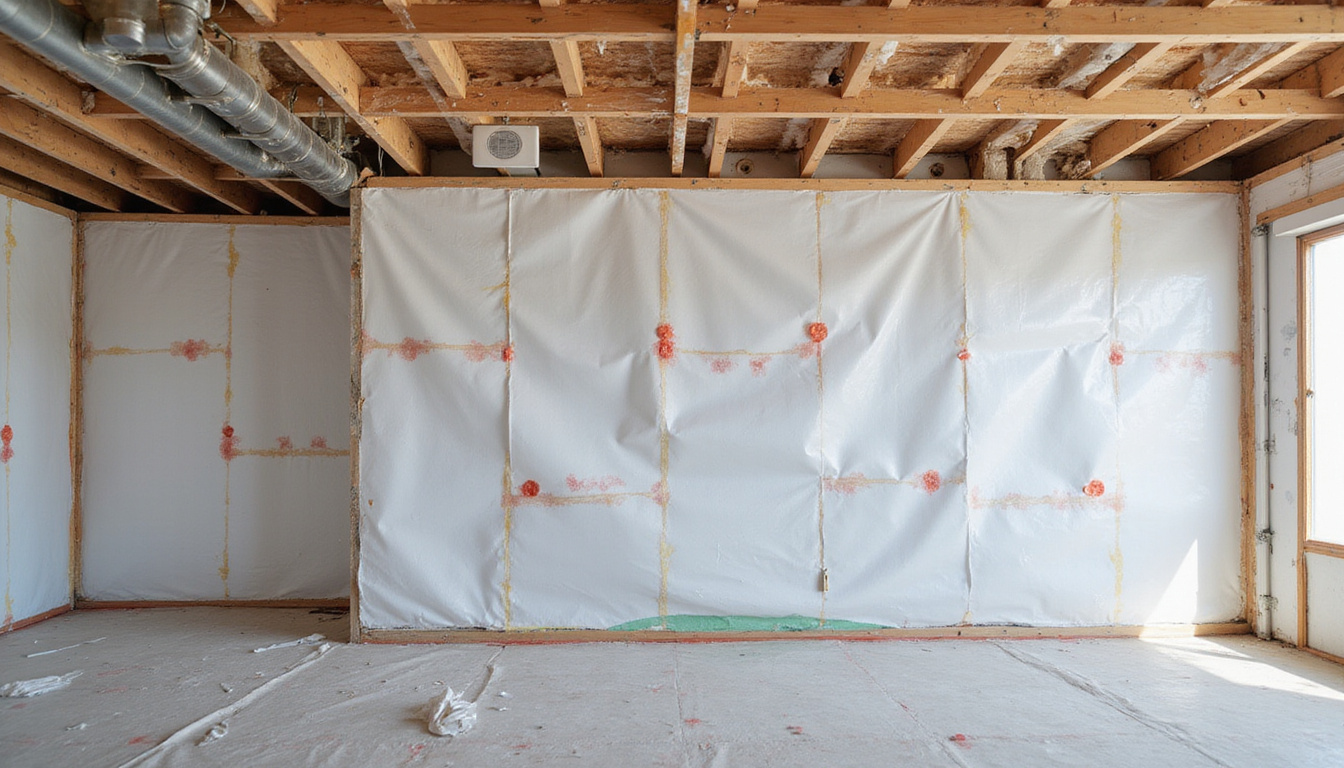
Mistake #4: Leaving Gaps, Tears, and Unsealed Seams
Even when the right material is used in the right place, sloppy installation causes many vapor barrier issues.
Common installation errors
- Untaped seams between sheets
- Tears and punctures around wiring and plumbing
- Gaps where the barrier should tie into other materials (e.g., at rim joists, top plates)
Why it’s a problem
While vapor diffusion is slow, localized weak spots and unsealed overlapped seams can still concentrate moisture movement and create cooler, wetter zones where condensation forms.
How to fix it
-
Inspect accessible areas.
Check in attics, crawl spaces, unfinished basements, and any areas under renovation. -
Repair and seal.
- Overlap seams by at least 6–12 inches.
- Use manufacturer-approved tape or sealant.
- Patch tears with compatible tape or small patches of the same membrane.
-
Maintain continuity.
- Ensure transitions (wall-to-ceiling, wall-to-floor) are continuous.
- Where different materials meet, use sealants or tapes designed for dissimilar surfaces.
Mistake #5: Ignoring Moisture Sources Before Installing a Vapor Barrier
A vapor barrier is not a cure for existing moisture problems. Installing one over damp materials often just traps that moisture inside.
Hidden moisture sources
- Roof or plumbing leaks soaking insulation or framing
- Capillary rise from foundations without proper damp proofing
- Poor site drainage directing water toward the foundation
- Unvented gas heaters adding water vapor indoors
Why it’s a problem
If you seal in existing moisture, you can accelerate:
- Decay of wood framing
- Rust in metal components
- Mold growth and indoor air quality issues
How to fix it
-
Investigate before you seal.
- Use a moisture meter on wood framing and sheathing where accessible.
- Look for staining, efflorescence, or musty odors.
-
Address bulk water first.
- Fix roof leaks, flashing, and plumbing issues.
- Improve grading and downspout discharge away from the foundation.
- Install or repair gutters.
-
Dry materials thoroughly.
- Use dehumidifiers and fans.
- In some cases, delay installing finishes to allow drying.
Mistake #6: Using the Wrong Vapor Barrier in Crawl Spaces
Crawl spaces are notorious for moisture problems. A poorly executed vapor barrier on the ground or walls can make things worse instead of better.
Typical crawl space errors
- Thin, easily torn plastic on the soil
- Gaps around piers and footings
- No sealing at perimeter walls
- No connection between ground vapor barrier and wall assemblies
Why it’s a problem
Moisture from the ground is a major source of indoor humidity and can lead to:
- Mold on floor joists
- Sagging subfloors
- Elevated radon and soil gas infiltration
- Higher cooling loads
How to fix it
-
Upgrade the ground vapor barrier.
- Use at least 6-mil poly; 10–20-mil is better in high-traffic crawls.
- Overlap seams by 12 inches and tape securely.
- Run the membrane up foundation walls several inches and mechanically fasten.
-
Seal around piers and penetrations.
- Cut tight-fitting pieces and tape or seal around supports.
-
Consider encapsulation.
- Add a continuous liner on walls and sometimes piers.
- Air seal vents and openings (if allowed by local code).
- Condition or dehumidify the crawl space to maintain relative humidity under ~60%.
Mistake #7: Forgetting About Drying Potential
The safest, most resilient assemblies aren’t those that completely block vapor—they’re those that control moisture and still allow safe drying, at least in one direction.
Why it’s a problem
If both sides of a wall or roof have low-perm layers (sometimes called a “double vapor barrier”), you can trap any moisture that gets inside:
- From small leaks
- Construction moisture
- Seasonal condensation
How to fix it
-
Avoid double vapor barriers.
- If you have low-perm exterior sheathing (e.g., foil-faced foam), don’t also install interior poly in many climates.
- Use vapor-retarder paint or smart membranes on the interior instead.
-
Plan a drying path.
- Design assemblies so any moisture can dry either inward or outward.
- Favor vapor-open materials (like mineral wool insulation, fiberboard, or permeable housewraps) when appropriate for your climate.
Quick Checklist: How to Get Vapor Barrier Installation Right
Use this list when planning or reviewing any vapor control work in your home:
- Identify your climate zone and seasonal vapor drive.
- Decide whether you need a vapor barrier, vapor retarder, or just vapor-open layers.
- Keep the air barrier and vapor barrier roles distinct.
- Place the vapor control layer on the correct side of the insulation.
- Eliminate bulk water issues before sealing anything up.
- Install with continuous coverage, sealed seams, and minimal penetrations.
- Avoid double vapor barriers; always allow a safe drying path.
- In basements and crawl spaces, use robust ground and wall membranes and manage humidity.
FAQ: Common Questions About Vapor Barriers
1. Do I really need a vapor barrier in my walls?
Not always. Whether you need a vapor barrier in walls depends heavily on climate, wall assembly, and local code. In many modern homes, a vapor retarder (like specialized paint or a smart membrane) offers better performance than a true vapor barrier, because it controls moisture without eliminating drying potential. Check your building code and consider a building-science-informed design rather than defaulting to poly everywhere.
2. What’s the best vapor barrier for a crawl space?
For a crawl space vapor barrier, use a thick, durable polyethylene (10–20 mil) that covers the entire soil surface, overlaps and taped seams, and runs up foundation walls. In many cases, combining this with wall liners, sealed vents, and some form of conditioning or dehumidification gives the best long-term control of moisture and mold.
3. Can I put a vapor barrier on basement walls?
A vapor barrier for basement walls must be handled carefully. Avoid interior poly directly against concrete in most climates, as it can trap moisture coming through the foundation. A better strategy is rigid foam insulation against the concrete, then framing and drywall. This approach controls vapor while still allowing the assembly to manage moisture safely.
Take Control of Moisture Before It Controls Your Home
Misunderstood or misapplied vapor barriers quietly damage homes for years before the signs—musty smells, mold, warped floors, peeling paint—finally show up. By placing vapor barriers correctly, distinguishing them from air barriers, avoiding double vapor traps, and addressing moisture sources first, you can dramatically increase your home’s durability, comfort, and indoor air quality.
If you’re planning a renovation or suspect existing vapor barrier problems, now is the ideal time to act. Start by mapping your home’s assemblies and climate, then consult a qualified contractor or building science professional to design the right vapor control strategy—not a one-size-fits-all roll of plastic. A small investment in doing vapor barriers right today can save you from expensive repairs and health concerns tomorrow.